
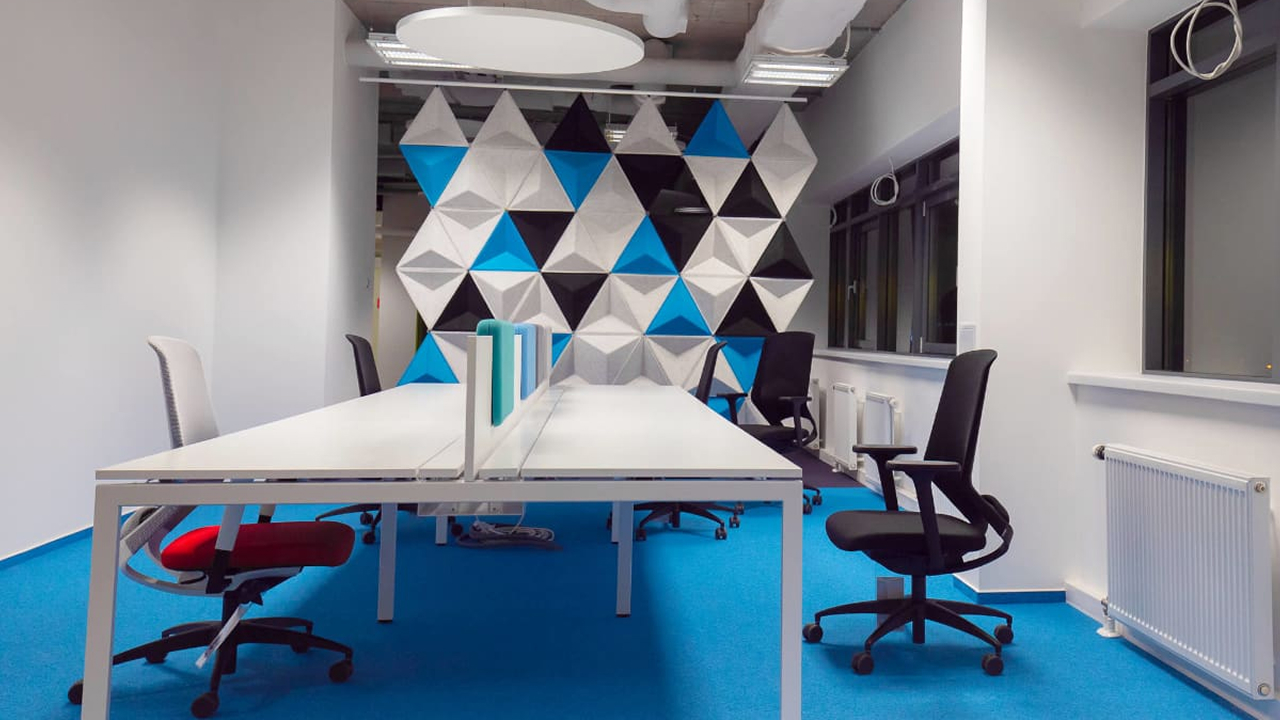
Office fit-out – what is it?
Fit-out can be described simply as creating a “tailor-made office”. The office space is prepared in such a way that it fully satisfies the needs of the company as an organization and that of the office users, i.e. the employees.
Fit-out is a comprehensive service. This means that a single company takes care of the entire operation, from the design of the space, the technical aspects and construction works involving the heating, ventilation, air conditioning, intelligent technologies, through to the fitting out of ergonomic workstations and communal spaces.
Fit-out work is carried out on the basis of a predetermined budget for the office design project and in accordance with the adopted schedule.
Improving office functionality – stages
Non-functional office spaces that do not make employees more effective and do not support the company in achieving its goals are a real nightmare for Polish offices. This challenge can be overcome by engaging a professional fit-out company.
What are the key steps in this process? The fundamental process is to improve the functionality of the office. The key, therefore, is a properly planned functional programme and a space plan.
Delineation of zones
The architectural design of an office must take into account the challenges that companies and their teams face today. The most important of these are:
- hybrid work or different teams for remote and office work;
- the need to optimise space through Activity Based Working and hot desk systems instead of traditional open-plan spaces;
- creating the role of the office as a place for teams to work and interact, rather than for individual work, which is increasingly done at home.
Today, office design is expected to ensure skilful division into different functional areas. Their selection depends on the working style of the organisation and its needs.
In addition to the individual work zone (desk, laptop) and communication zone, there are also work zones for smaller or larger teams, various types of meeting rooms and teleconference areas or acoustic booths.
Every office should also contain an area where employees can relax and interact with one another. Office cafés and canteens are a basic feature, but such solutions as hammocks, playrooms, office gyms and relaxation areas are also becoming increasingly common. They facilitate integration with the company and improve mutual relations between employees.
Taking into account the needs of employees
The professional functional office design that you obtain as part of the fit-out service will be based on a detailed analysis of the needs of your organisation. A functional analysis serves as a basis for a good plan. It takes into account the work model, the number of employees and the scope of their tasks, as well as establishing whether places for meetings with customers, conference rooms and places for individual and team work are required.
It is also important to know how the company communicates and what technologies it needs, as well as what hinders the work of employees in the existing office.
What are employees paying particular attention to today and what are the necessary components which must be incorporated in the design of a modern office?
- Ergonomic workstations equipped with modern furniture that can be freely adapted to the needs of employees: e.g. desks for working while sitting and standing, ergonomic office chairs and their alternatives, such as dynamic sitting solutions;
- access to natural light, as well as adequate illumination of workstations with lighting of an appropriate colour and intensity;
- access to fresh air and greenery: opening windows, potted plants, office garden and green walls;
- access to places where employees can relax and integrate: a café with good coffee, a well-equipped office kitchen, an office gym, sofas, hammocks – the home office is an important trend in modern design!
Office aesthetics
Once a functional programme has been created and the needs of employees and of the organisation as a whole have been taken into account, the next step is to take care of the aesthetics of the office, i.e. make sure that the design has an appropriate style.
Office design
The appearance of an office should be consistent with the nature of the business and the preferences of the employees. In addition, it must reflect and support the company’s mission, values and goals.
See our comprehensive office portfolio!
With the growing significance of remote working, today’s modern offices tend to fulfil a representative function. They also integrate employees around shared values and the company. Therefore, a stylish office design plays an absolutely crucial role today – it attracts new employees, helps them identify with the company and highlights its values.
In doing so, it is worth remembering that the colours in the office (especially in workspaces) should be rather neutral to promote concentration. In communal spaces, on the other hand, it may be worth opting for vivid and bright colours to create a surprise and wow effect!
Technologies for office use
An important part of any fit-out service is also the implementation of modern technologies that increase the comfort of office use and reduce maintenance costs. What is particularly worth paying attention to?
Intelligent building management systems
Building automation plays a key role in every modern office building project today.
Offices often implement intelligent control systems for blinds, lighting, air conditioning, ventilation, and heating – making it easy to improve working conditions without having to personally control particular settings.
Alarm systems are responsible for security but there are also other convenient solutions, such as integrated room access control systems or cashless payment for using the office canteen.
Work comfort is also enhanced by automatic air quality control and improvement or by implementing different music zones within the office.
High-speed Internet access
At the clients’ request, the fit-out company also designs and installs internet connections. It installs low-voltage electrical systems, such as SSP, DSO, CCTV, SSWIN or LAN. Thanks to our comprehensive services, investors can be sure that the new office design will fully support the company’s business goals, whereas the internet access will improve work efficiency.
Remote work support
In times when so many employees perform tasks from home, it is essential for a well-organised office to be adequately equipped with technologies that enable employees to work remotely in a safe environment.
Therefore, a properly configured and secured company network must be provided so that remote work and hybrid work (partly from home, partly from the office) does not involve the risk of losing important company data and resources.
Energy saving aspects
Increasing numbers of companies are adding sustainable management to their core organisational goals. Saving resources like water and energy is also necessitated by their rapidly rising costs. This is why intelligent solutions are put in place in modern offices to optimize the use of energy.
How does it work? Building automation systems are equipped with presence and occupancy sensors that activate lighting or heating systems only when and where they are needed. Monitors and other equipment are unplugged, for example, in the evening to avoid the consumption of electricity while on standby. Unused rooms go into sleep mode, saving energy.
The consumption of all resources is also carefully monitored and measured to optimize costs. As a result, offices modernised by means of fit-out services immediately achieve energy savings.
Heating, ventilation, and air conditioning
Modern intelligent systems control the ventilation, air conditioning and heating systems in the building. All this happens automatically, bringing considerable savings and improving the level of work comfort for employees.
Another important aspect is caring for the quality of air. Air quality monitoring and automatic management systems are implemented so that employees can work more efficiently and take fewer sick days.
Water saving systems
Today, modern offices should have water-saving systems in place. Solutions such as low-flow toilets and electronically controlled fixtures are worth implementing too. Innovative ideas like using captured rainwater are also increasingly common in office buildings.
Choosing eco-friendly solutions
Going green in the office is not just a fad these days, but a way to achieve real savings. Commonly used eco-friendly solutions include the use of photovoltaic panels and other systems to generate one’s own energy, appropriate use of air conditioning and furnishing the office with recycled furniture.
In addition, increasing numbers of companies are doing away with unnecessary equipment and opting for things like eco-friendly paper and environmentally friendly office supplies.
Summary
A functional, modern and employee-friendly office is the best recipe for improving business operations. An office fit-out is not just about new spaces. Existing offices can also be redesigned to suit the needs of their users.
It is important to have the fit-out carried out by professionals with extensive market experience and a wide portfolio of completed projects. DM Builidng is such a company. Check out our projects and learn more about what we offer today!

